
Tap on the screen
Uranus and Its Rings
Webb Adds Another Ringed World
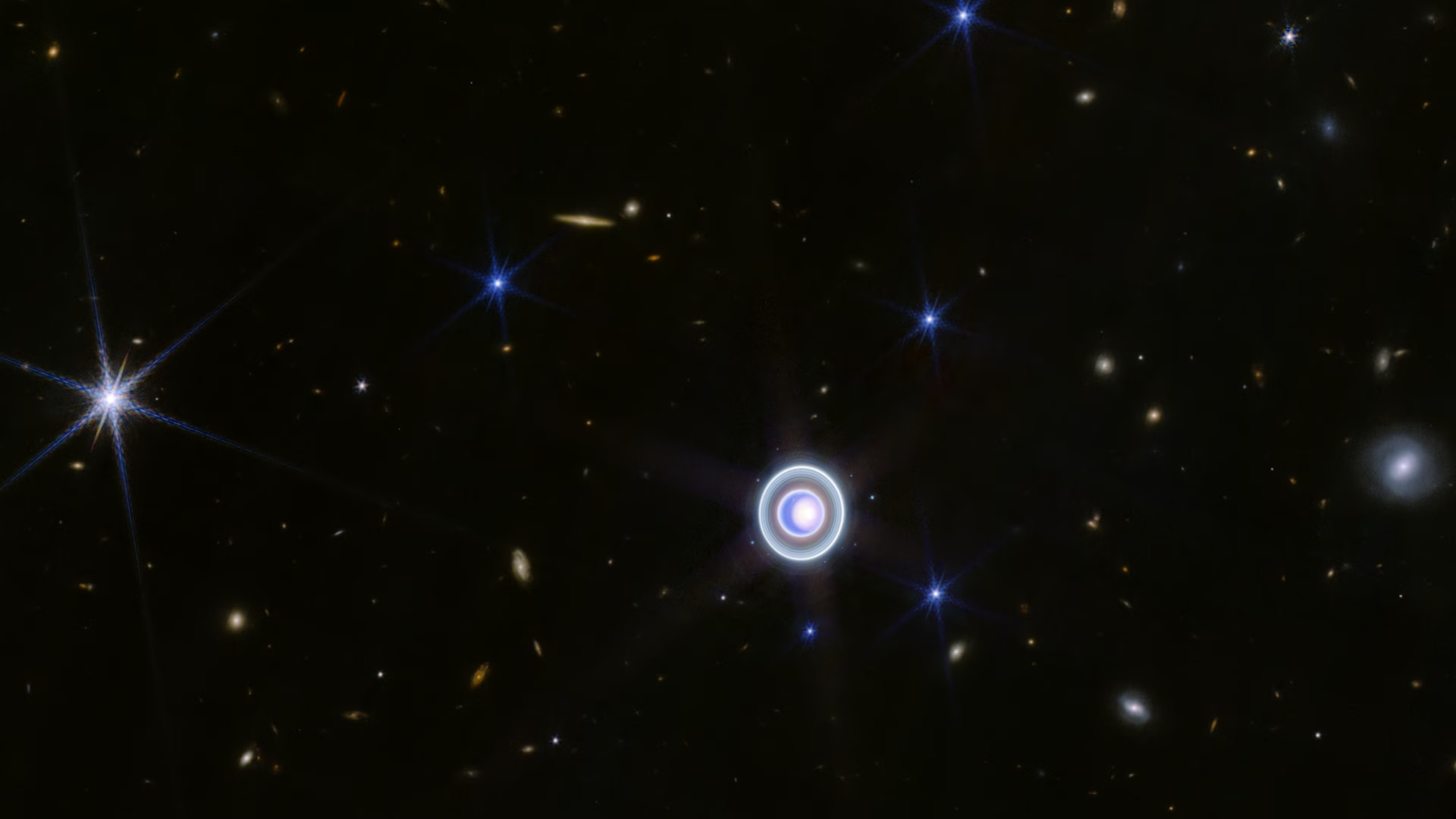
Following its 2022 portrait of Neptune, Webb turned its NIRCam instrument toward the Solar System's other ice giant. The resulting image shows Uranus as few have ever seen it: a pale blue sphere wrapped in dramatic rings, with bright atmospheric features and a glowing polar cap.
Eleven of the planet's 13 known rings are visible here, including faint dusty rings so subtle that only two facilities had ever imaged them before: Voyager 2 during its 1986 flyby, and the Keck Observatory using advanced adaptive optics. Where the rings sit close together, Webb's sensitivity makes them appear to merge into single bright bands.
Uranus is the strangest planet in the Solar System in one key way: it rotates on its side, tilted nearly 90 degrees from the plane of its orbit. Each pole spends 42 years in constant sunlight followed by 42 years of total darkness. The bright cap in this image marks the northern pole, in late spring at the time of observation.
Remarkably, this was only a 12-minute exposure using two filters, a hint of what Webb can do when it studies this mysterious world in depth.
HIDE
INFO

About WebbShift
WebbShift is an independent, interactive gallery presenting remarkable images captured by the James Webb Space Telescope. Explore distant galaxies, stellar nurseries, planetary systems, and some of the deepest views of our universe.
Created by Alex Hartan, it is designed to make these extraordinary observations more immersive and accessible, and to spark greater curiosity about the cosmos.
Enjoyed this? Drop me a message, or share it with another astronomy nerd.
Images courtesy of NASA, ESA, CSA, and STScI. WebbShift is an independent project and is not affiliated with these organizations.