

NIRCam
MIRI
Tap on the screen
NGC 604: Cradle of Giants
A Tapestry of Star Birth in the Triangulum Galaxy
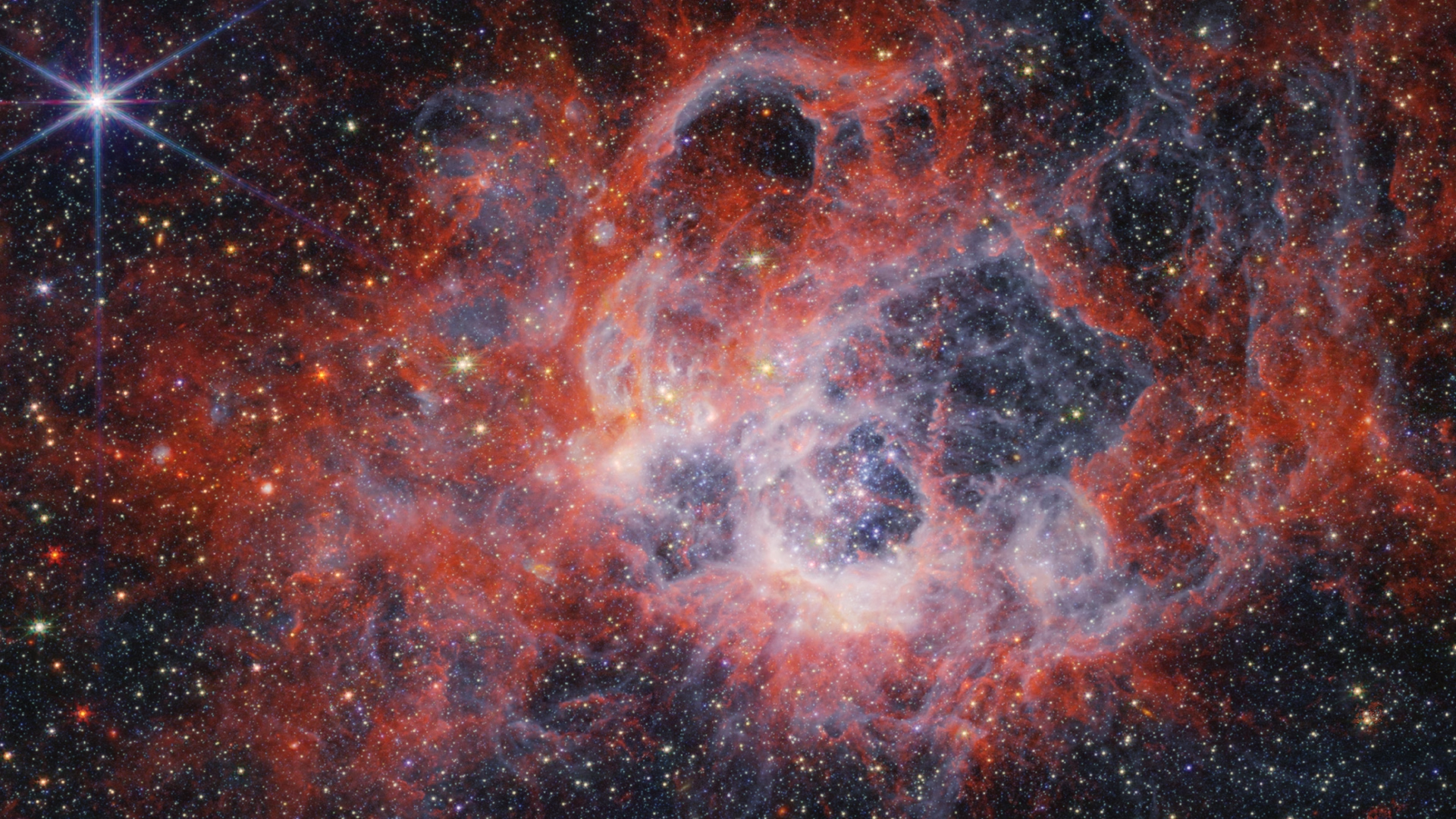
NGC 604 is a vast star-forming region in the Triangulum Galaxy, 2.73 million light-years from Earth. It offers astronomers something rare: a dense concentration of very young, massive stars close enough to study in detail, with more than 200 of the hottest and most massive stellar types packed into a single region.
In Webb's near-infrared view, stellar winds from these bright young stars carve cavernous bubbles into the surrounding gas and dust. The bright orange streaks trace carbon-based molecules known as polycyclic aromatic hydrocarbons, while deeper reds mark cooler molecular hydrogen, the prime raw material for future stars.
A ghostly white and blue glow of ionized hydrogen threads through the scene, lit by ultraviolet radiation. Together, the bubbles and stretched filaments form a more detailed and complete tapestry of star birth than any previous view of this region.
HIDE
INFO

About WebbShift
WebbShift is an independent, interactive gallery presenting remarkable images captured by the James Webb Space Telescope. Explore distant galaxies, stellar nurseries, planetary systems, and some of the deepest views of our universe.
Created by Alex Hartan, it is designed to make these extraordinary observations more immersive and accessible, and to spark greater curiosity about the cosmos.
Enjoyed this? Drop me a message, or share it with another astronomy nerd.
Images courtesy of NASA, ESA, CSA, and STScI. WebbShift is an independent project and is not affiliated with these organizations.