
Tap on the screen
Cassiopeia A
Inside the Shattered Shell of Cassiopeia A
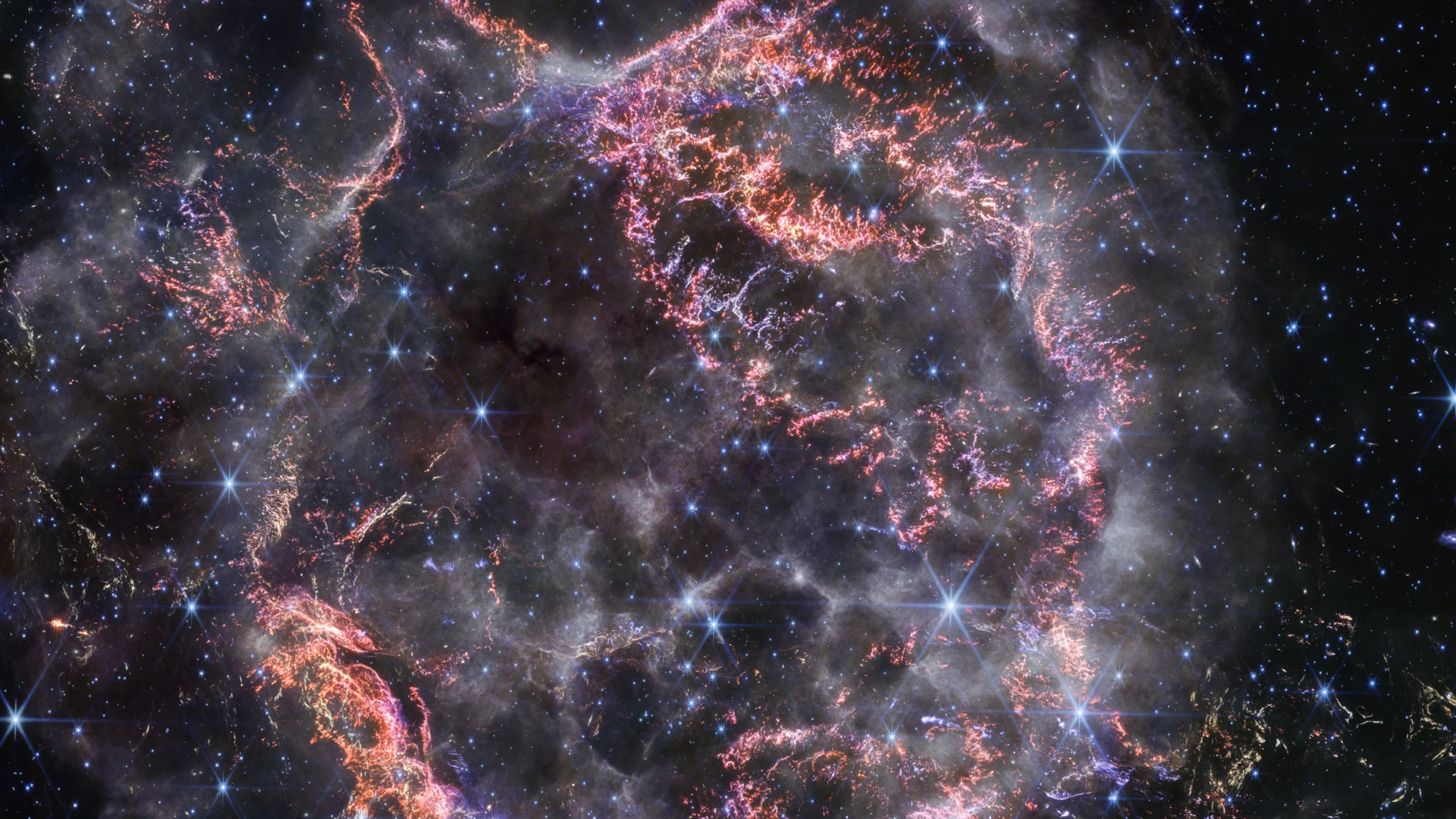
Cassiopeia A is the youngest known remnant of a massive exploded star in our galaxy, located about 11,000 light-years away and spanning roughly 10 light-years across. Webb's NIRCam instrument delivers a high-definition view of the expanding shell of debris slamming into the gas the star shed before it died.
The most striking colors are the clumps of bright orange and light pink forming the inner shell. These are tiny knots of gas composed of sulfur, oxygen, argon and neon from the star itself, resolvable only thanks to NIRCam's exquisite sharpness. Their structure offers researchers a hint of how the dying star shattered like glass when it exploded.
The outskirts of the shell resemble smoke from a campfire, marking where ejected material rams into surrounding circumstellar gas. The white glow there comes from synchrotron radiation, produced by charged particles spiraling around magnetic field lines at extreme speeds.
HIDE
INFO

About WebbShift
WebbShift is an independent, interactive gallery presenting remarkable images captured by the James Webb Space Telescope. Explore distant galaxies, stellar nurseries, planetary systems, and some of the deepest views of our universe.
Created by Alex Hartan, it is designed to make these extraordinary observations more immersive and accessible, and to spark greater curiosity about the cosmos.
Enjoyed this? Drop me a message, or share it with another astronomy nerd.
Images courtesy of NASA, ESA, CSA, and STScI. WebbShift is an independent project and is not affiliated with these organizations.